
Do you live in a watershed? Your answer should be yes. Everyone lives in a watershed. A watershed is all the land that drains to a particular waterbody. Within each watershed, all water runs to the lowest point (a stream, river, or lake). Water travels over the surface or seeps into the soil and travels as groundwater. A watershed is also called a drainage basin or a catchment area.
Watersheds are systems that include land, soils, plants, wetlands, animals, and people. All of these affect the water flowing through the watershed to the streams and rivers. What we do within the watershed affects waters for many miles downstream. If the land is not properly managed, there could be harmful effects to the waters including erosion, flooding, and degraded water quality.
There are three watersheds in Trumbull County. These include the Grand River Watershed, the Mahoning River Watershed, and the Pymatuning/Shenango Watershed.
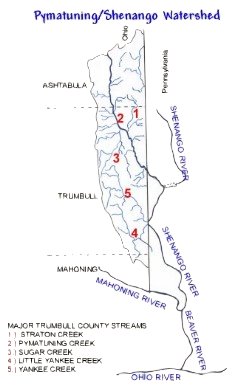
The Pymatuning/Shenango Watershed is approximately 1, 065 square miles or roughly 682, 310 acres. The watershed includes portions of Ashtabula, Trumbull, and Mahoning counties in Ohio and Crawford, Mercer, and Lawrence counties in Pennsylvania. Major waterbodies include Pymatuning Creek, Pymatuning Lake, Shenango Reservoir, and the Shenango River. Pymatuning Lake is the largest impounded waterbody in Pennsylvania and the Shenango River provides drinking water for four cities and five boroughs.
The Pymatuning system flows approximately 70 miles. It begins as Pymatuning Creek in Ashtabula County, Ohio and Shenango River in Crawford County, Pennsylvania. These join at the Shenango River and flow south to to join with the Mahoning River to form the Beaver River, which joins with the Ohio River.
Land Use
Almost half (46%) of the watershed is in agriculture. A small percent is developed (5%) but concentrated in areas such as Hubbard, Ohio, Sharon, Pennsylvania, and New Castle, Pennsylvania. Forty-nine percent is comprised of woods and wetlands. The Shenango wildlife area, Pymatuning Lake, and Shenango Reservoir are considered some of the more ecologically sensitive areas along river corridors and are protected as game/wildlife refuges or as recreation areas.
What is harming the Pymatuning/Shenango?
Some pollutants of concern include nutrients, metals, chlorine, PCBs, pathogens, and sediment. Channelizing and altering stream beds, clearing vegetation, failing septic systems, development or agriculture without best management practices (BMPs) are all ways in which water quality can be degraded.
What can you do?
Get involved! Get to know your watershed. Taking care of our resources can be as simple as cleaning up your trash. There are many ways to help. Contact your local Conservation District or watershed group to learn more.
Watershed Associations in the Pymatuning/Shenango
Penn Ohio Watershed Association: The mission of the Penn Ohio Watershed Association is to foster the protection and restoration of the Pymatuning/Shenango River Watershed through grassroots conservation efforts and voluntary cooperation with the entire watershed community. For more information contact the following:
Amy Reeher
520 W. Main Street, Suite # 3
Cortland, Ohio 44410
Phone: (330) 637-2056, ext. 8624
Email: amy@trumbullohswcd.org
Pymatuning Lake Association
PO Box 1737
Andover, OH 44003
Phone: (724) 927-6879
Email: info@pymatuninglake.com
Web site: www.pymatuninglake.com
Shenango River Watchers
PO Box 986
Sharon, PA 16146
Phone: (724) 342-5453
Email: shenangoriver@hotmail.com
Web site: www.shenangoriverwatchers.org
For more information on the Grand and Mahoning River Watersheds, click here.
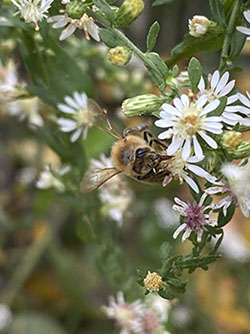
The Pollinator Pursuit was developed to be a hands-on, interactive environmental competition focused on the importance of pollinators for students in grades 6th - 8th. The competition is open to schools in Ohio (Ashtabula, Trumbull, and Mahoning Counties) and Pennsylvania (Crawford, Mercer, and Lawrence Counties). This competition will be virtual. For more information, contact Amy Reeher at 330-637-2056, ext. 8624 or amy@trumbullohswcd.org
All links below are in PDF format and will open in a new window.

Pollinator Pursuit Program Flyer
The 2021 Trumbull SWCD Pollinator Pursuit Virtual Event Registration Form
2021 Pollinator Pursuit Study Material:
Attracting Pollinators to the Garden
What is “Pollination” & What is a “Pollinator"?
Stream Watch is a voluntary stream water quality monitoring program originally provided by the Trumbull County Health Department through an Ohio EPA Educational Grant. Students from schools throughout Trumbull County collect macroinvertebrates, which are tiny organisms without a backbone that can be seen by the naked eye - insect larva, nymph, etc. The organisms are collected into a three-foot square net by rubbing rocks in an area of fast moving water, or riffle. Once collected, participants sort and identify the organisms, record their results, and assign a rating of stream health based on their sampling.
To request more information, to schedule an introduction to Stream Watch for your classroom or to schedule a monitoring session, please contact Amy Reeher, Watershed Coordinator at (330) 637-2056, ext. 8624 or amy@trumbullohswcd.org.
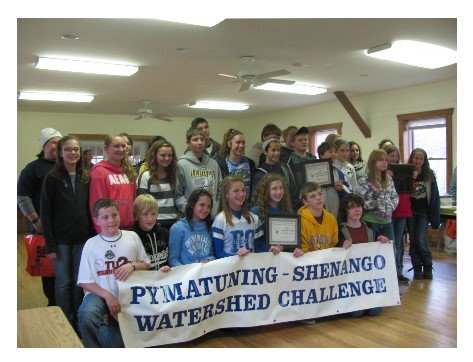
The Pymatuning/Shenango Watershed Challenge is a hands-on, interactive environmental competition for students in grades 6th - 8th. The competition is open to schools in Ohio (Ashtabula, Trumbull and Mahoning Counties) and Pennsylvania (Crawford, Mercer and Lawrence Counties). Schools may send up to two teams of 3 to 5 individuals.
As a team, the students answer questions on aquatics, forestry, soils, watersheds and wildlife. The teams get the chance to meet with specialists from each of these areas and after the competition, enjoy a light lunch and an awards ceremony.
2026 Junior Envirothon/Watershed Challenge Flyer
2026 Junior Envirothon/Watershed Challenge Registration/Release Form
Aquatics Study Material:
What's A Macroinvertebrate? Why Are They in the Water?
How Do We Test Water Quality? And What Does It Mean?
Macroinvertebrate Life in the River
10 Least Wanted Aquatic Nuisance Species
Forestry Study Material:
Forestry Resource - Soils & Water Quality
The Threat of Non-Native Forest Insects and Diseases
Trees for People: Urban Forestry 101
Forestry Information - Tree I.D.
Soils Study Material:
Healthy Soils are Full of Life
Watersheds Station Study Material:
Where is Your Watershed? (Ohio River - Ohio)
Where is Your Watershed? (Lake Erie- Ohio)
Working Trees for Water Quality
Wildlife Station Study Material
Common Birds of Ohio Field Guide
For more information, please contact: Amy Reeher, Watershed Coordinator |