
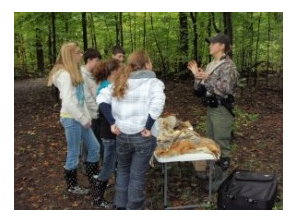
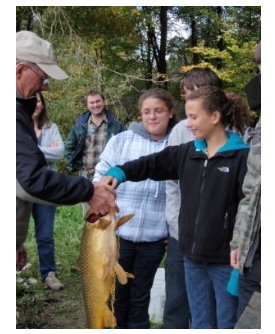
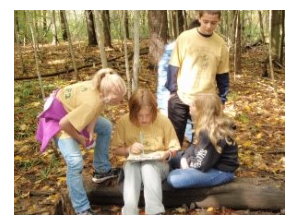
Thousands of teac hers and professionals throughout the United States and Canada guide students through the Envirothon each year. The Envirothon program combines classroom learning with outdoor activities, culminating in competitions at the area level (North East Ohio), state and international levels. This exposure to nature from a critical perspective and the understanding of human impacts on the natural world provide invaluable lessons, helping students understand ecosystems and our environment.
Envirothon teams are tested on their knowledge in five topic areas: Soils and Land Use, Aquatic Ecology, Forestry, Wildlife and a Current Environmental Issue. They are exposed to scientists and experts in each of the above fields, working hard, but having fun while learning. Open to high school students, a team may be sponsored by a high school, home schooled group or a scout or community service group. Each school can send two teams of five members each.
For more information on the Envirothon visit the North American Envirothon website at www.envirothon.org, or contact Trumbull SWCD at (330) 637-2056, X 8624, amy@trumbullohswcd.org

How Well Would You Do?
Try these sample questions from past Envirothons:
1. Poor soil structure negatively influences which of the following?
a. pH
b. Soil stability
c. Source of topsoil
d. Water movement
2. Forested watersheds provide many benefits to the ponds and streams in them. Of the following, which is NOT a benefit of a forested watershed?
a. Warmer water
b. Erosion control
c. Shading
d. Flood control
3. Soil erosion from cleared land is a significant source of nonpoint source pollution. All of the following practices will reduce soil erosion EXCEPT
a. Disturbing the smallest amount of land possible
b. Increasing the slope of the area by grading
c. Maintaining good vegetative cover
d. Mulching or maintaining crop residue
4. Wetland are best defined by the presence of
a. Permanent standing water
b. Certain types of animals
c. Hydrologic conditions, hydric soils and hydrophytic vegetation
d. Microbes, shells and trees
5. Dendochronoligists study tree rings to identify many historical events. When they find a growth ring wider than the previous rings this may indicate
a. A better growing season
b. A poorer growing season
c. A higher tree population next to this tree
d. Neighboring trees have blown over, allowing this tree more space
e. A and D
6. Coyotes have become quite numerous in this area. Which animals make up the largest percentage of the coyote’s diet?
a. Deer
b. Rabbits and pheasants
c. Deer mice and meadow voles
d. Song birds
e. Livestock
7. The major reason many types of animals migrate from Ohio in winter is
a. To escape cold weather
b. To escape predators
c. To find a proper source of food
d. To spend more time in the sun
ANSWERS: 1.d, 2. a, 3. b, 4. c, 5. e, 6. c, 7. C
The Junior Envirothon is an outdoor competition for Trumbull County students in grades 6 thru 8. Schools may send up to two teams of 4 or 5 individuals and each school must be represented by one coach (teacher, parent or school administrator). As a team, the students field questions on soils, forestry, wildlife, aquatics and the year's current environmental issue. The teams will meet with specialists from each of these areas and after the competition, enjoy a light lunch and an awards ceremony.
2026 Junior Envirothon/Watershed Challenge Flyer
2026 Junior Envirothon/Watershed Challenge Registration/Release Form
Aquatics Study Material:
What's A Macroinvertebrate? Why Are They in the Water?
How Do We Test Water Quality? And What Does It Mean?
Macroinvertebrate Life in the River
10 Least Wanted Aquatic Nuisance Species
Forestry Study Material:
Forestry Resource - Soils & Water Quality
The Threat of Non-Native Forest Insects and Diseases
Trees for People: Urban Forestry 101
Forestry Information - Tree I.D.
Soils Study Material:
Healthy Soils are Full of Life
Watersheds Station Study Material:
Where is Your Watershed? (Ohio River - Ohio)
Where is Your Watershed? (Lake Erie- Ohio)
Working Trees for Water Quality
Wildlife Station Study Material
Common Birds of Ohio Field Guide
For more information, contact Trumbull County SWCD at (330) 637-2056, ext. 8624 or email: amy@trumbullohswcd.org.



| Nonpoint Source | Rain Gardens |
| Runoff | Nutrients |
| Watershed | Sediment |
| Monitoring | Pesticide |
| Conservation | Fertilizer |
| Environment | Xeriscape |
| Water | Riparian |
| Pollution | Erosion |
| Low Impact |
| A | N | O | N | P | O | I | N | T | S | O | U | R | C | E |
| N | P | U | L | O | W | I | M | P | A | C | T | I | O | P |
| L | T | S | T | N | E | M | I | D | E | S | W | P | R | A |
| O | W | A | T | R | N | B | K | C | M | L | E | A | A | C |
| N | A | F | D | U | I | Y | F | F | O | N | U | R | I | S |
| O | T | E | W | O | T | E | R | B | W | T | N | I | N | I |
| I | E | R | Y | L | P | M | N | R | G | C | D | A | G | R |
| T | R | T | P | O | L | L | U | T | I | O | N | N | A | E |
| A | S | I | E | M | S | T | D | W | S | R | I | F | R | X |
| V | H | L | S | K | B | W | K | J | U | R | S | L | D | N |
| R | E | I | T | C | T | U | A | S | O | I | M | R | E | O |
| E | D | Z | I | P | L | V | O | T | A | W | Z | H | N | I |
| S | E | E | C | M | F | H | I | R | E | D | L | M | S | S |
| N | E | R | I | A | N | N | K | G | P | R | H | P | M | O |
| O | D | I | D | V | O | C | M | D | J | T | J | E | G | R |
| C | T | N | E | M | N | O | R | I | V | N | E | T | R | E |